

Elephant Dog Toys: Materials, Sizes, and Play Styles
You've probably watched your dog carry a plush elephant to the door, only to find the ears gone, a seam split, and stuffing scattered across the floor like confetti. That's the point where owners stop asking whether the toy was cute and start asking whether they bought the wrong toy.
Elephant dog toys look like novelty items, but the right one can handle fetch, tug, comfort chewing, and squeaky play without turning into trash in a day. The pet-toy market was valued at USD 9.60 billion in 2025 and is projected to reach USD 17.24 billion by 2034, with a 6.74% CAGR over the forecast period, which tells you this category is both large and still growing (Fortune Business Insights). Dogs dominate demand in pet toys, and chew toys remain one of the leading formats, so an elephant shape only matters if the toy's structure fits the dog in front of you, not the photo on the package (Future Market Insights).
Table of Contents
- Why Elephant Dog Toys Are Worth a Second Look
- What Counts as an Elephant Dog Toy
- Materials and Construction Explained
- Sizes, Weights, and Geometry That Matter
- Matching Toys to Play Styles and Dog Profiles
- Safety, Durability, and the Power Chewer Question
- Building a Toy Rotation That Stops the Shredding Cycle
Why Elephant Dog Toys Are Worth a Second Look
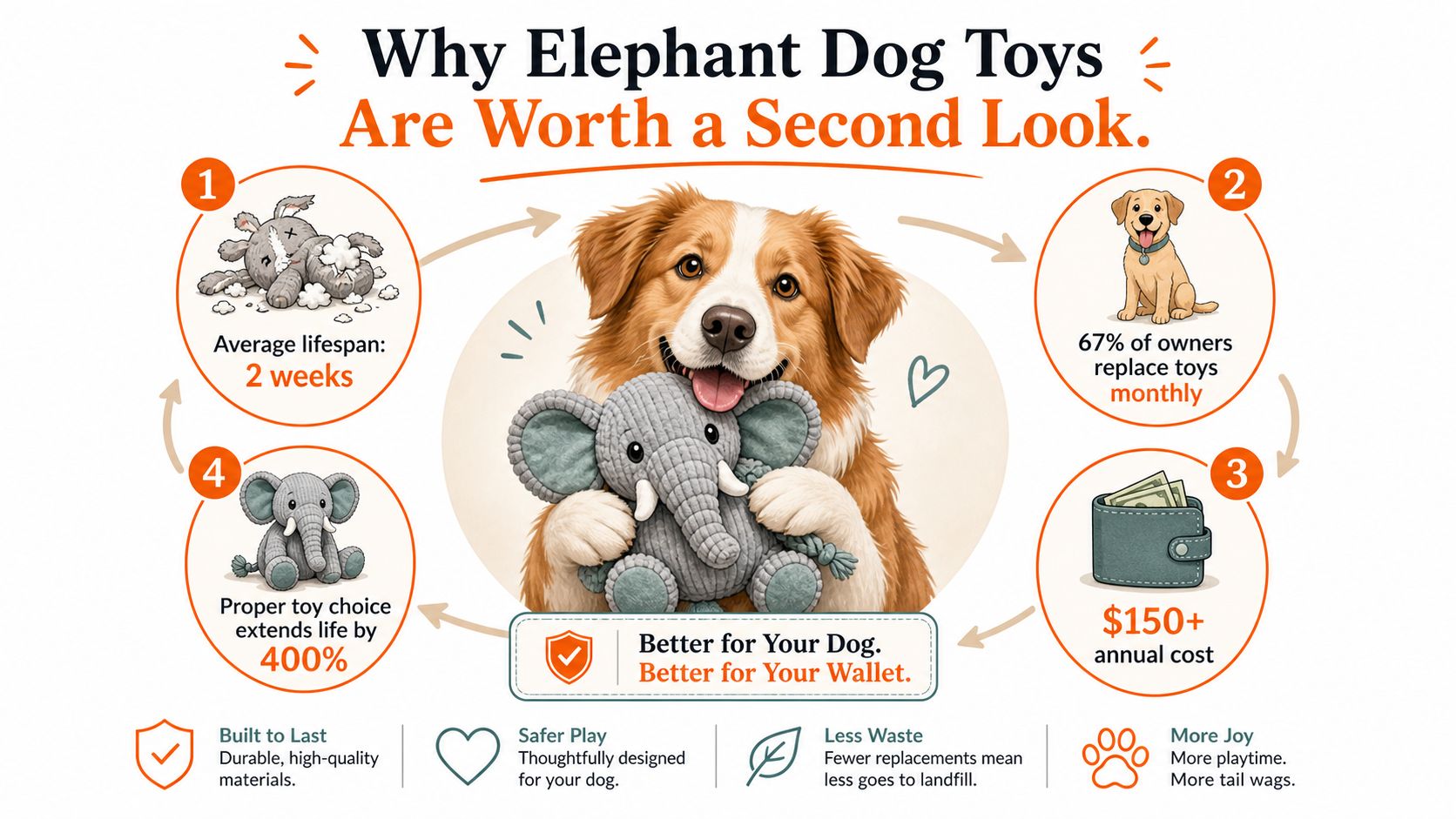
A dog drags in a plush elephant with one ear hanging by a thread, then drops it at your feet like a trophy. That scene is familiar because plush toys usually fail at the same weak points, seams, stuffing, and flimsy details, not because the animal shape itself is a bad idea.
The shape keeps showing up for a reason
Elephant toys keep coming back because the silhouette works. The trunk gives dogs an easy place to grab, the ears create flappy motion for shaking games, and the body gives manufacturers room for squeakers, rope, or reinforced panels. That makes the shape useful for more than one kind of play, which is why you keep seeing it in plush bins, tug aisles, and gift-style pet displays.
Practical rule: if a toy's shape helps your dog grip, shake, or carry it, the toy has earned its shelf space. If the shape only looks cute, it won't last.
The bigger point is this, novelty doesn't predict durability. A dog toy shaped like an elephant can be soft and disposable, or it can be built for serious use with stronger seams, layered fabric, and smarter internal structure. The difference is what keeps you from buying the same toy over and over.
Why shoppers keep getting fooled
Shoppers often choose with their eyes first. They see a smiling elephant, a squeaker, maybe a rope tail, and assume the toy will fit their dog. In reality, a plush elephant for a calm snuggler and a tug elephant for a high-energy adolescent are completely different purchases even if the front photo looks similar.
That's why the question isn't “Is this elephant cute?” It's “What job is this toy supposed to do?” Once you answer that, the field gets smaller fast. You can stop buying throwaway toys and start buying toys that stay in rotation.
What Counts as an Elephant Dog Toy
An elephant dog toy isn't one product type, it's a shape applied to several very different constructions. That matters because the label can hide the actual behavior of the toy, and behavior is what determines whether it survives a week or disappears under the couch in pieces.
The main format families
Classic plush is the version most shoppers recognize first. It usually combines a soft fleece or polyester outer shell, internal stuffing, and a squeaker, which makes it appealing for carrying, cuddling, and light wrestling.
Stuffless designs remove filling to cut down on mess and shift the toy's load toward the shell, seams, and any rope or crinkle components. They're useful when a dog loves to tear open plush toys but still wants a soft body to bite and shake.
Rope-reinforced elephants mix fabric with rope limbs, rope trunks, or rope backing. Those toys give tug dogs a firmer grip and can spread pull force better than a standard plush body.
Rubber or hybrid toys use the elephant silhouette as a shell for chewing or treat-dispensing. These are less common in the gift-style aisle, but they're the right lane for dogs that need a more structured mouth feel.
Why the label isn't enough
A toy called “elephant” can be plush, squeaky, crinkly, rope-heavy, or nearly all rubber. The name tells you the shape, not the function. That's why smart shoppers read the construction notes first and the cute name second.
If you're looking in a pet store, the plush and rope versions usually sit in the main toy aisle, while the more specialized chew or enrichment versions tend to show up in niche sections or boutique-style collections. The shape is the same. The play pattern is not.
Materials and Construction Explained
A soft elephant toy can be tougher than a stiff-looking one if the inside is built better. That's the part most buyers miss, they focus on the outer fabric, when the key question is how the toy is assembled.
Construction architecture beats surface material
Tuffy's elephant toys show why construction matters more than the look of the fabric. The brand's elephant designs use up to 4 bonded layers and as many as 7 rows of stitching, and its Zoo Series pairs a soft fleece exterior with industrial-grade luggage material inside and a plastic-coated core (Tuffy product page). That's a very different product from a single-layer polyester plush with one seam running around the middle.
The outer feel can fool people. A toy may be soft in the hand and still be built with serious internal reinforcement. That's why shoppers should look for language about layer count, reinforced seams, and internal backing, not just “durable” or “premium.”
Direct advice: ignore the word “plush” until you've checked the seam count, backing material, and whether the toy was designed for play or chewing.
Stuffing, seams, and squeaker placement
Stuffing changes the failure pattern. Filled toys give dogs something to rip out, which creates cleanup and shortens the useful life of the toy once a seam opens. Stuffless toys reduce that mess, but they still need strong edges, because the toy can fail where the body flexes most.
Squeaker placement matters too. If the squeaker sits right where the dog's jaws land every time, the toy may die quickly even if the rest of the shell looks solid. Good construction spreads stress away from a single weak spot. Bad construction puts all the pressure in one place and hopes the dog won't notice.
For buyers, the takeaway is simple. A rugged-looking elephant is not automatically a rugged toy. The toy survives when the architecture holds, and architecture is what separates a toy that becomes a favorite from one that becomes landfill.
Sizes, Weights, and Geometry That Matter
A toy's dimensions tell you how it moves in a dog's mouth. That matters more than marketing copy, because a toy that's too small can be swallowed, and one that's too large does not fit the way the dog wants to carry or shake it.
Small carry toys and long tug toys
KONG's Shakers Elephant is marketed at 13.5 × 2.75 × 3.75 inches and 0.18 lb for small dogs, which makes it a compact occupy toy rather than a heavy tugger (Target listing). At the other end of the range, fabdog's Twisty Elephant reaches 60 inches long and 1.8 lb, which pushes the design toward long-form tug and drag play rather than solo carry work (Target listing).
Those numbers matter because geometry changes how force travels through the toy. A short, compact plush concentrates pressure near the mouth and trunk. A long toy spreads pull force over more length, which can make tugging feel more satisfying and can keep the toy from disappearing into the dog's mouth in one gulp.
Use the dimensions as a play clue
A toy's proportions tell you its real job. A small, light elephant usually suits carrying, light shaking, and low-intensity play. A long body or extended limbs usually signals tugging, fetch, or human-assisted play.
| Format | Typical Size Range | Key Construction Feature | Best Play Style |
|---|---|---|---|
| Compact plush elephant | Small, easy to mouth | Stuffed body, squeaker | Carry, cuddle, light fetch |
| Stuffless elephant | Varies, often mid-size | No filling, reinforced shell | Shake, toss, light tug |
| Rope-backed elephant | Mid-size to large | Rope limbs or back panel | Tug, interactive play |
| Long tug elephant | Extra long | Extended body and distributed stress points | Two-dog tug, human-dog play |
If the photo shows a giant elephant but the description says “small dog,” trust the dimensions, not the staging. Geometry tells the truth.
Matching Toys to Play Styles and Dog Profiles
The best elephant toy depends on the dog's habits, not the owner's taste. A calm lap dog, a mouthy adolescent, and a heavy chewer all need different structures, even if they'd all look adorable carrying the same elephant.
Four dog profiles, four very different picks
Small-breed snuggler. Choose a compact plush or stuffless elephant with soft edges and a manageable body size. This dog usually wants something to mouth, carry, or nap beside, not a giant tug toy that bangs into furniture.
Fetch-obsessed adolescent. Pick a medium toy with a visible trunk or rope element that's easy to grab and easy to throw. The dog needs motion, not decoration, so the toy should fly cleanly and survive repeated pickups.
Power chewer. Skip the cutesy plush-first models unless the construction is clearly reinforced. A chewer needs layered fabric, stronger seams, or a hybrid design that resists puncture and tearing. In many cases, an elephant shape is a compromise, not the ideal chew answer.
Anxious dog. Choose a soft elephant that functions as a comfort object, ideally one without a load of stuffing. Noise-sensitive dogs often do better with a quiet toy that can stay near their bed or crate without becoming a cleanup project.
Match the toy to the behavior, not the fantasy
A toy that satisfies the wrong behavior becomes a mess fast.
That's why stuffless and rope-backed elephant toys deserve more attention than the standard stuffed version. The stuffless toy reduces interior chaos. The rope-backed toy gives tug players a better grip point and takes some stress off the fabric body. The plush body still keeps the elephant look, but the function changes completely.
The same logic applies to breed and size. Small mouths need a toy they can wrap around. Big, hard mouths need more structure or they'll shred the toy from the first session. If you buy for the dog you have, the elephant can fit into fetch, tug, or calm time without becoming a one-day purchase.
Safety, Durability, and the Power Chewer Question
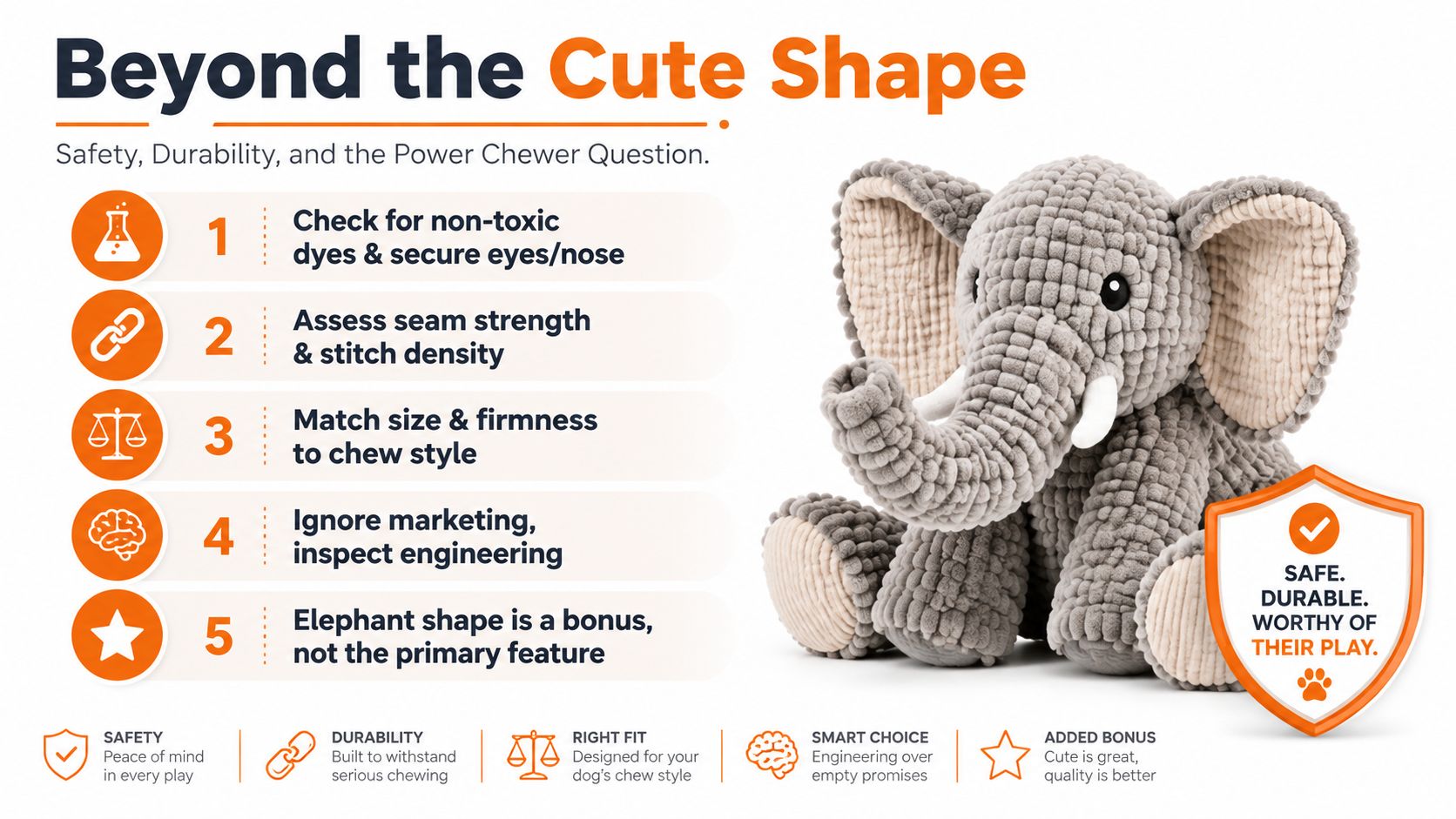
The cute shape is the least important part of the decision. What matters is whether the toy matches your dog's chewing style and whether it can fail safely when it starts to wear out. Humane guidance also stresses that owners should inspect toys for wear and rotate them regularly, which is exactly the mindset buyers need for elephant toys that lean plush, squeaky, or cuddly (Humane World for Animals).
The real failure modes
The first failure mode is a torn seam that opens the toy and releases stuffing. The second is a swallowed squeaker, which is a serious problem because that small part was never meant to become a snack. The third is frayed rope fibers or loose stitched-on features such as eyes or decorative pieces.
Those problems show up fast in dogs that shred, tear, or dig at weak points. A toy can look fine on the shelf and still fail badly once a dog gets traction on the trunk, ear, or belly seam.
What to inspect before the toy enters the basket
- Check the seams: Look for tight stitching, doubled seams, and clean joins at the ears, legs, and trunk.
- Test the small parts: Eyes, noses, and add-on details should feel secure, not like they'll peel away on the first hard bite.
- Match firmness to chewing style: Plush works for gentle dogs, stronger structures are better for dogs that bite through soft shells.
- Ignore the photo first: The stuffed elephant in the ad may not resemble the toy your dog needs.
- Retire worn toys early: If stuffing is visible, stitching is split, or the squeaker area feels loose, the toy is done.
The power chewer question has a blunt answer. If your dog regularly destroys plush toys, buy with that history in mind, not with hope. The right elephant toy is the one that survives long enough to be useful and fails in a controlled, obvious way when it's time to replace it.
Building a Toy Rotation That Stops the Shredding Cycle
One toy is a setup for boredom and overuse. A simple rotation keeps the elephant toy interesting longer and gives you a cleaner way to spot wear before the dog turns a weak seam into a full teardown.
A simple weekly system
Keep three to four toys in active rotation, with one elephant-shaped toy assigned a job. That job might be fetch, comfort, light chew, or tug, but it should be specific. If the elephant is the tug toy, don't also make it the bedtime toy and the backyard chew.
Once a week, inspect the toy in your hand. Squeeze the squeaker, tug the seams, and check the trunk, ears, and feet for exposed stuffing or loose stitching. If the toy fails any of those checks, retire it before your dog does.
Buyer checklist: size match, construction quality, intended play style, and replacement budget. If a toy misses one of those, don't buy it.
How I'd shop it
A dog that likes to carry and settle down can use a plush elephant as comfort gear. A tug dog needs a longer or rope-backed shape. A destroyer needs the most reinforcement you can find, and even then I'd treat the toy as a supervised item instead of an all-day chew.
The Bark Side carries dog toys as part of its pet lineup, so it's a place to check if you're comparing toy options in one storefront. If you want an elephant dog toy that fits your dog's size and play style, browse The Bark Side and look for the construction details first, the cute face second.
If you're buying your dog's next elephant toy, shop the structure, not the silhouette. The Bark Side gives you a single place to browse pet supplies alongside other everyday items, and that makes comparison easier when you want a toy that fits your dog's chewing style instead of another shredded plush in a week.
Enhanced by Outrank