

Wood Dog Toy Safety, Types, and Care Guide
You're on the rug, one eye on your dog and one eye on your phone, and the chew in their mouth looks harmless enough. It's stick-shaped, quiet, and clearly keeping them busy. Then the edge frays, a shard goes missing, or the toy shrinks to a size that makes you wonder whether you should take it away right now.
That moment is where wood dog toy decisions happen. The question isn't just whether wood feels natural. It's whether the chew is sized correctly, whether the material is engineered for your dog's jaw, and whether it's still safe enough to keep in rotation.
The broader market makes the category look simple from a distance, but it isn't small or fringe. Future Market Insights estimates the United States dog toys market at USD 4,669.7 million in 2025, with a projection of USD 6,587.1 million by 2035 at a 3.5% CAGR, and says chew toys will account for 42.90% of revenue by 2025. That matters because wood-based chew products live inside a category where chewing is already the main behavior, not an odd use case.
Table of Contents
- Why a Wood Dog Toy Might Be the Right Chew
- What Actually Counts as a Wood Dog Toy
- Materials, Shapes and Textures Explained
- Matching the Chew to Your Dog's Size and Style
- When a Wood Dog Toy Becomes Unsafe
- Wood Dog Toys Versus Rope, Rubber and Synthetic Chews
- Cleaning, Inspecting and Storing a Wood Dog Toy
- Choosing the Right Wood Dog Toy for Your Dog
Why a Wood Dog Toy Might Be the Right Chew
A dog settled on a stick-like chew can look like the easiest win in the world. The room is quiet, the furniture is safe for the moment, and the dog seems satisfied. That's exactly why so many owners reach for wood first, because it feels like a natural answer to a natural habit.
Chewing Is the Main Job Here
The market data backs up that instinct. In the United States dog toy market, chew toys are expected to account for 42.90% of total revenue by 2025, which tells you where buyers put their money and attention, according to Future Market Insights. Wood-based chews fit neatly into that behavior pattern because they're built around gnawing, not fetch or tug.
Practical rule: if your dog wants to mouth, gnaw, and work a toy for a while, you're already in the right decision zone for a chew product rather than a novelty toy.
That said, wood isn't automatically the best answer. The same behavior that makes it appealing, repeated chewing, is also what exposes weak points in the material. A good wood chew has to survive compression, repeated bites, and the wear pattern your dog creates over time.
A lot of owners buy the first wood-looking option they see and only discover the trade-off later. The chew may be entertaining, but if it splinters easily or gets too small too fast, it stops being a convenience and starts becoming a disposal decision. That's why the rest of this guide keeps coming back to thresholds, not branding language.
What Actually Counts as a Wood Dog Toy
The phrase wood dog toy covers more than one thing, and that's where confusion starts. Some products are literal branches or sticks, some are purpose-built pet chews made from natural wood, and others only look wood-like while being engineered to behave differently in a dog's mouth.
Three Different Categories Get Mixed Up
Real sticks from outside are the most unpredictable option. They vary in hardness, grain, cracks, dirt, and failure mode, so one branch can feel dense and another can break into sharp pieces quickly. That unpredictability is why many training guides push buyers toward purpose-made alternatives rather than backyard wood.
Purpose-built natural wood chews are the cleaner version of the idea. They're shaped for dogs, sized for jaws, and sold as pet products instead of found objects. A good example is a natural wood chew line sold in cherry blossom wood with 10 cm, 13 cm, and 16 cm lengths at a constant 1.6 cm thickness, which shows how manufacturers control geometry instead of relying on random branch shape, as noted by MindUp's product listing.
Composite and wood-derivative chews sit in a different lane again. They may aim for the feel of wood, but they add formulations meant to reduce splintering and improve consistency. That distinction matters because a toy that looks like a branch isn't always trying to behave like one.
The bigger market context supports the category's durability. Grand View Research estimates the global pet toys market at USD 10.61 billion in 2025, and projects USD 22.42 billion by 2033, with a 9.9% CAGR from 2026 to 2033, according to Grand View Research. In plain terms, wood-based chews are part of a category that's growing, not disappearing.
A product label that says “wood” tells you almost nothing by itself. The real question is whether you're holding a raw stick, a shaped natural chew, or a wood-like engineered alternative.
Materials, Shapes and Textures Explained
The differences that matter most are the ones you can see and measure. Wood species, thickness, length, surface texture, and composite reinforcement all change how long a chew lasts and how it behaves under pressure. The more a product page gives you on those points, the better your odds of choosing well.
Geometry Beats Vague Natural Language
A natural wood chew sold in 10 cm, 13 cm, and 16 cm lengths at 1.6 cm thickness shows one common approach, which is to standardize cross-section and length for specific dog sizes. That's not just merchandising, it's bite-control logic. A thicker, more uniform chew usually gives the mouth a more consistent surface to work against.
Engineered wood-derivative chews take a different path. Some explicitly call out lead-free and phthalate-free construction while trying to reduce splintering, which shifts the product from “raw natural material” toward “controlled chewing object.” That's useful for owners who like the wood feel but don't want untreated branch behavior.
Ridges and textured surfaces matter too. A textured chew can create more contact with teeth and gums as the dog works it, which gives the toy a cleaner oral-feel profile than a smooth stick. It doesn't turn a chew into dental treatment, but it does explain why some products are shaped the way they are.
| Construction type | Typical lengths | Splinter behavior | Best fit |
|---|---|---|---|
| Natural shaped wood | Fixed sizes like 10 cm, 13 cm, 16 cm | More dependent on grain, thickness, and chewing force | Dogs that like a firmer, more natural-feeling chew |
| Engineered wood-derivative | Varies by product line | Designed to reduce splintering | Owners who want a wood-like experience with more consistency |
| Textured wood-alternative chew | Product-specific | Built for controlled wear rather than raw branch failure | Dogs that benefit from a safer mimic material |
Read the spec sheet the way you'd read a tool spec. If the product tells you the material, thickness, and intended size range, it's doing real work. If it only says “natural wood,” you're guessing.
Matching the Chew to Your Dog's Size and Style
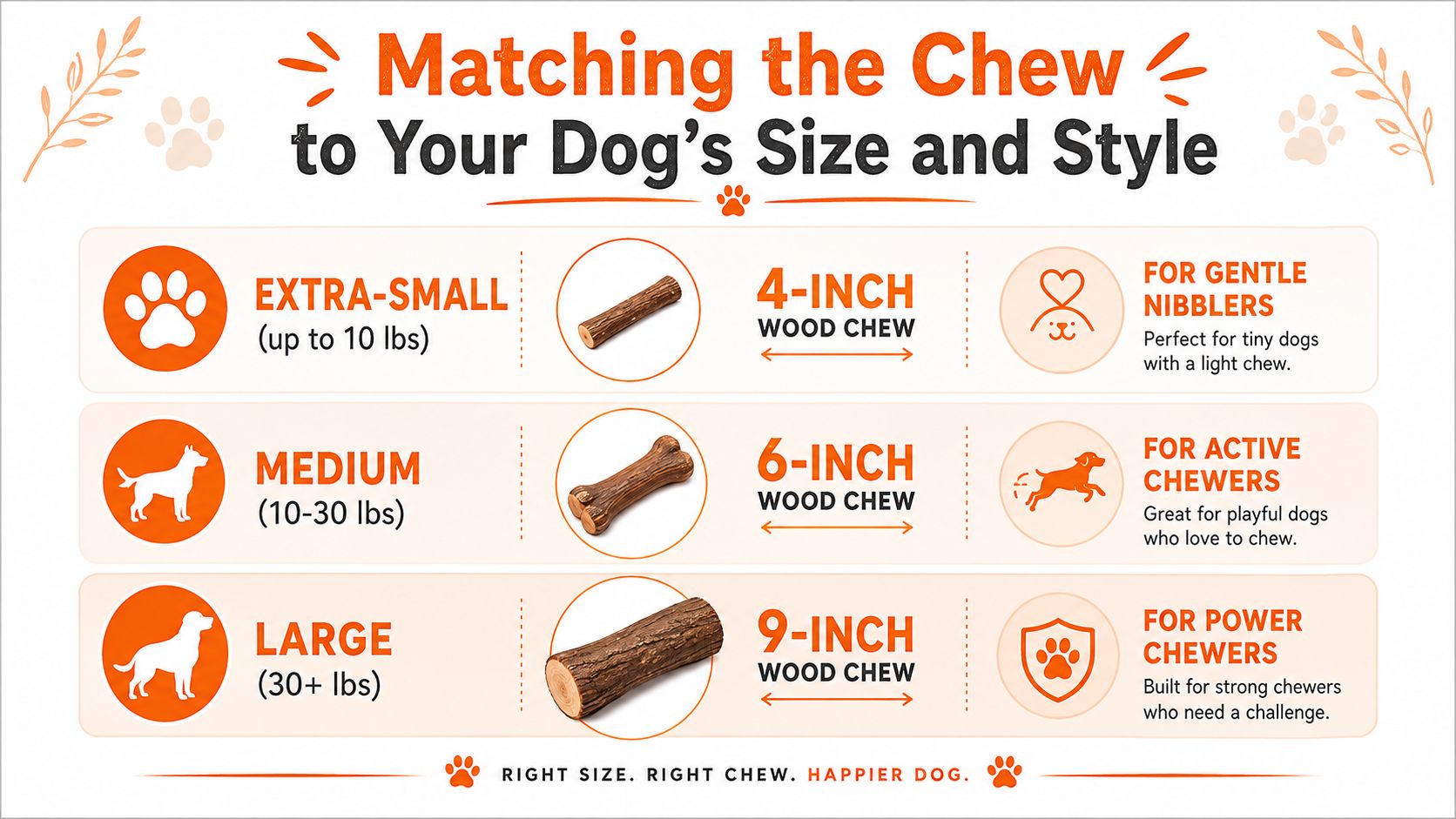
Sizing is where a lot of wood chew problems begin. A chew that's too small becomes swallowable faster than owners expect. A chew that's too large can sit awkwardly in the mouth and frustrate a dog that wants to work with their back teeth.
Weight Class Is the First Filter
One established sizing example lists an extra-small chew at 4 inches for dogs up to 15 lb, small at 5 inches for up to 20 lb, medium at 7.25 inches for up to 35 lb, and large at 8 inches for dogs 50 lb and over, according to Canadian Pet Connection's product example. That kind of ladder shows how geometry is tied directly to bite-force management.
The jump between sizes matters because dog mouths don't scale in a neat, linear way. A tiny chew can disappear into a bigger dog's mouth before you're ready for it to. A larger chew gives more room for jaw engagement, which is usually the safer setup for determined chewers.
Practical rule: if you're undecided between two sizes, the safer choice is usually the larger one, as long as your dog can still grip it comfortably and work it under supervision.
Chewing Style Decides the Final Call
A calm senior dog and a powerful adolescent chewer should not get the same chew just because they're close in weight. The softer chewer usually needs a product that's easy to engage without being so small that it vanishes too quickly. The stronger chewer needs more length, more mass, and a design that's meant for repeated compression.
If your dog is between sizes, watch what they do with other chews. Do they hold them in the front of the mouth, or do they clamp down hard and grind? Do they strip material quickly, or do they gnaw patiently? Those habits tell you more than the label does.
When a Wood Dog Toy Becomes Unsafe
This is the part most owners miss. A wood chew doesn't fail all at once, it crosses a line. The problem can be a sharp fragment, a piece that gets too small, or a product that starts to break down in a way that's easier to swallow than to chew.
Supervision Is Not Optional
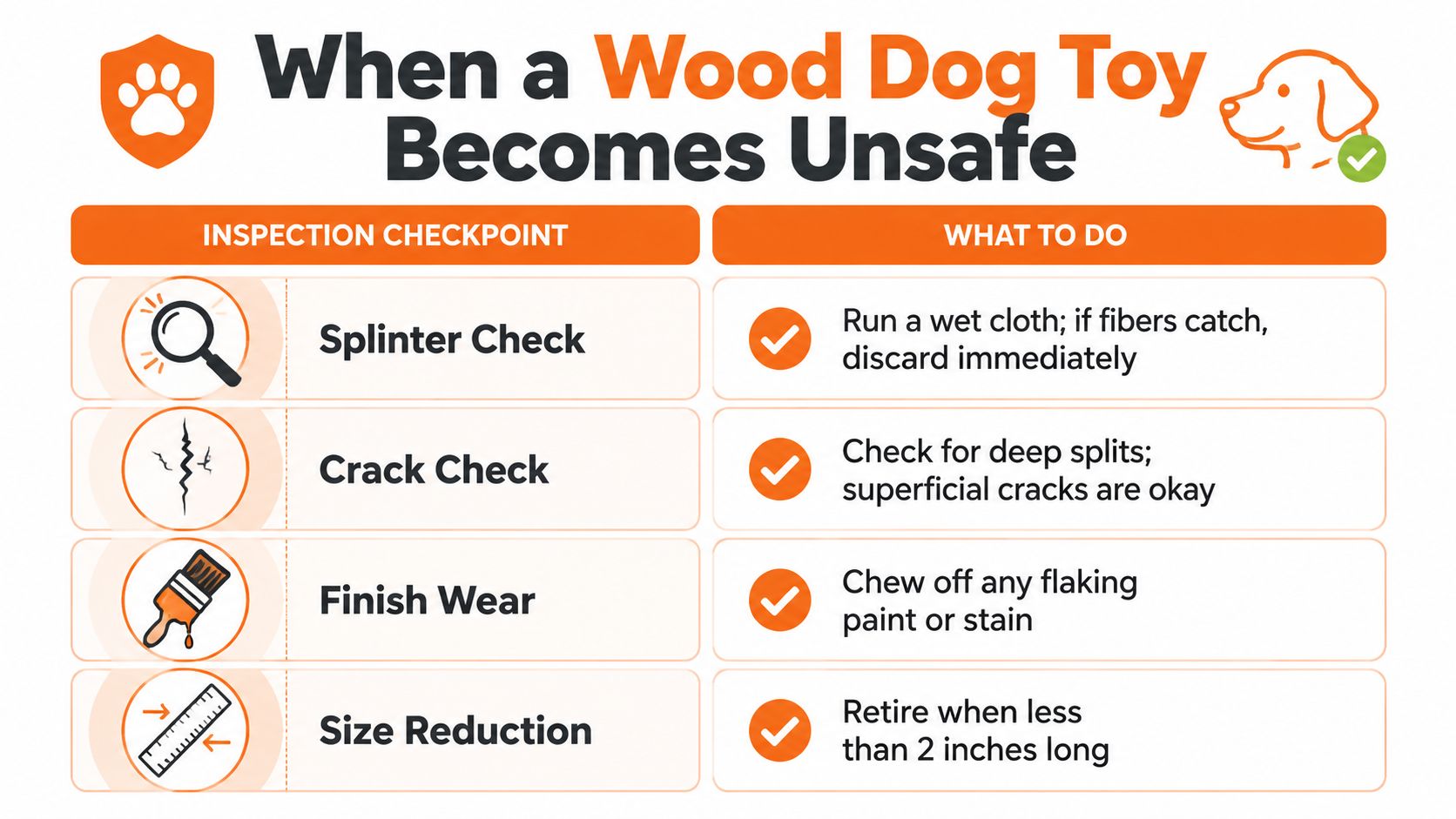
Independent guidance says wooden chews should be given only under supervision, should be large enough that the dog cannot swallow them, and should be replaced once they become small enough to ingest, according to the guidance video. That is the baseline, not the advanced version.
If you've seen a chew sit in the dog bed for days and slowly get smaller, you already know why this matters. The hazard is not dramatic. It's incremental. Owners usually notice it only after the toy has crossed from “busy object” to “swallowable object.”
The Warning Signs Are Simple
Look for splintering, deep splits, pieces that flake off, or a size that now fits too easily in the back of the mouth. If the toy has fillers or breaks down in a way that suggests ingestion risk, it shouldn't stay in circulation. A wood chew is a supervised tool, not a permanent possession.
If you can't tell at a glance whether the chew is still too large to swallow, it's probably time to retire it.
That rule is especially important for dogs that chew hard and fast. A toy that looks acceptable in the morning can become a different object by evening. Treat it like a wear item with a visible endpoint, not like a durable bone substitute that lasts forever.
Wood Dog Toys Versus Rope, Rubber and Synthetic Chews
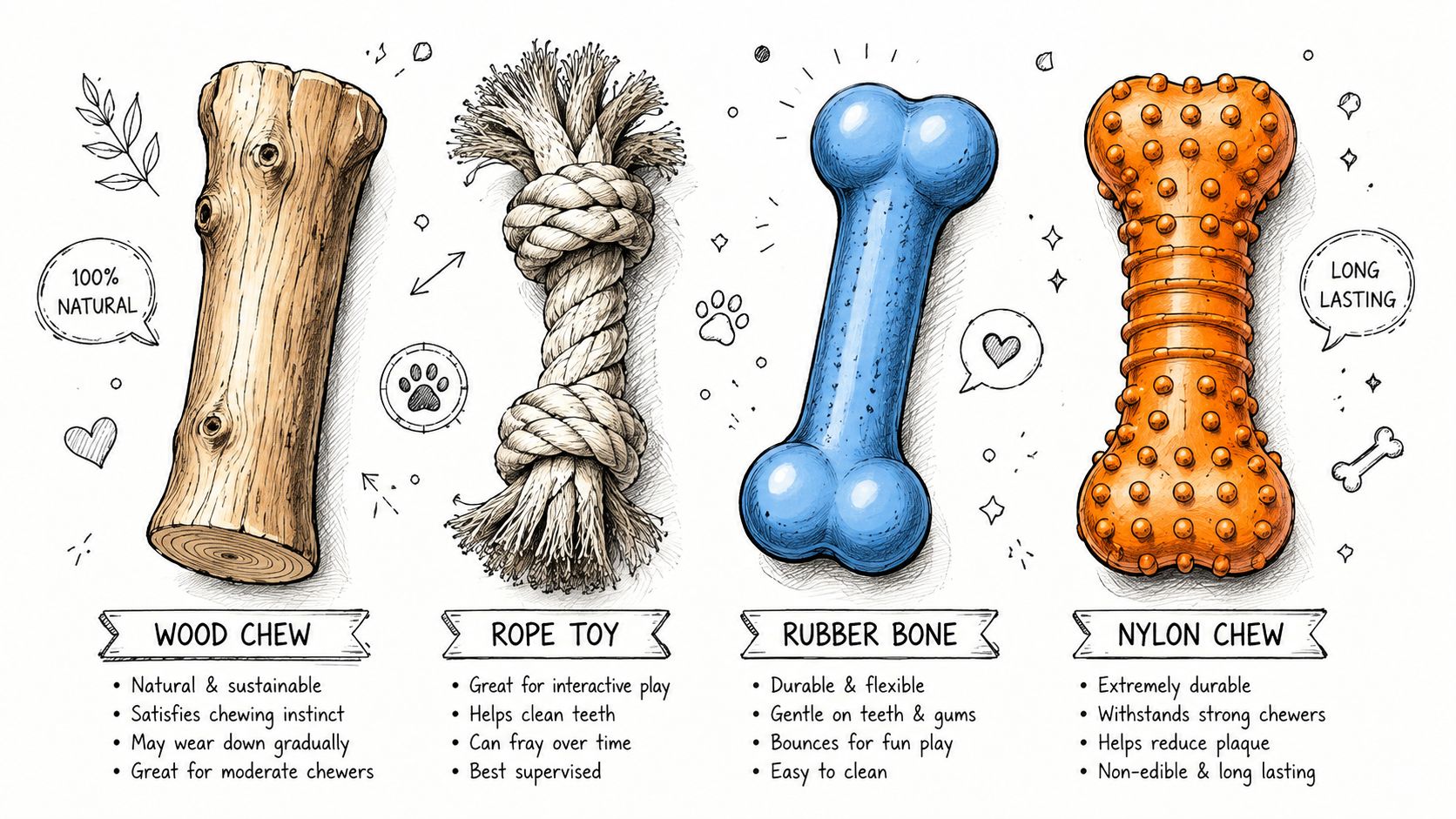
Wood sits in a wider family of chew options, and it doesn't always win. Rope, rubber, and synthetic wood-look alternatives each solve a different problem, which is why the best choice depends on the dog, not the trend.
The Right Material Depends on the Risk You're Managing
Rope chews can be satisfying for dogs that like tugging and shredding, but they tend to create a mess and need close watch when strands start separating. Rubber chews are often the better choice for dogs that like compression and bounce, especially if you want a toy that handles heavy jaw work with less splinter concern.
Synthetic wood-look chews are the interesting middle ground. Brands and training guides increasingly frame wood-based products as alternatives to sticks and furniture chewing, with more emphasis on wood alternatives and real wood stick alternatives than on raw wood itself, according to Foundation Dog Training. That shift says a lot about where the smart money is going for dogs that love the feel of wood but shouldn't be given unpredictable branches.
A good rule of thumb is simple:
- Choose wood when the dog likes firm, supervised gnawing and the chew is sized correctly.
- Choose rubber when you want more durability and less splinter risk.
- Choose rope when tug and texture matter more than longevity.
- Choose a synthetic wood-look chew when your dog loves branch-like texture but you want a safer substitute.
The contrarian point is important. For some dogs, the safest answer isn't “more natural.” It's more controlled.
Cleaning, Inspecting and Storing a Wood Dog Toy
A wood chew lasts as long as its care routine allows. If you leave it damp, ignore wear marks, or toss it back into the toy bin without checking it, you shorten its safe life and make the next session harder to judge.
A Small Routine Goes a Long Way
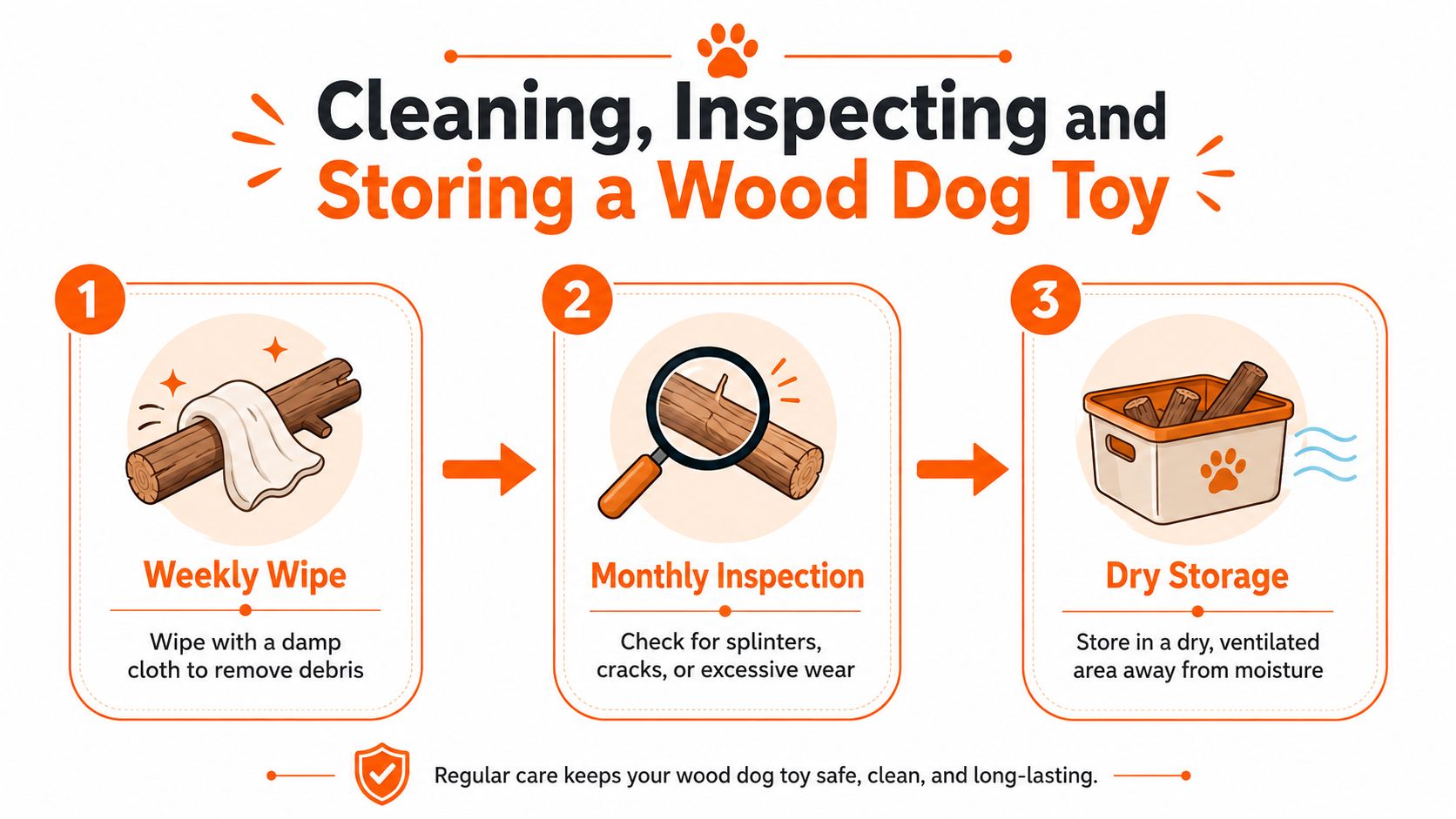
Wipe the chew with a damp cloth after use so saliva and debris don't sit on the surface. Then let it dry fully before storage. Moisture trapped in a chew is one of the easiest ways to ruin a toy that would otherwise have been fine.
Inspect it under good light for splinters, deep cracks, and worn-down ends. You're not looking for perfection, you're looking for shape changes that make the toy more swallowable or more likely to fail on the next session. If the surface smells off, looks soft, or has dark spots that suggest moisture damage, retire it.
Store It Like a Wear Item
Keep it in a dry, ventilated spot away from humidity and direct sun. A bagged-up chew in a warm, damp corner is asking for trouble, and direct heat can make wood more brittle over time.
A simple weekly checklist works well:
- Wipe clean: Remove residue after each chewing session.
- Dry fully: Don't store it while still damp.
- Inspect closely: Check ends, seams, and any ridges for new wear.
- Retire early: If the chew no longer feels structurally stable, toss it.
Choosing the Right Wood Dog Toy for Your Dog
A casual chewer can often do well with a shaped natural chew, as long as the size is right and you watch the wear. A strong chewer usually does better with a more engineered option, especially if you want a product that resists splintering more predictably. A dog with a history of swallowing fragments or shredding toys quickly may be better off with a synthetic wood-look alternative instead of real wood.
The cleanest buying process is also the shortest. Measure your dog, choose a size bracket, pick the safest material profile for their chewing style, and set a replacement rule before the toy comes home. If you need a one-week plan, make it this, measure first, buy second, supervise every session, and inspect before the next one.
The Bark Side carries a wide range of everyday pet-friendly products in one easy place, which makes it simple to shop thoughtfully instead of grabbing the first chew you see. If you're comparing options and want a store that keeps convenience in mind, visit The Bark Side and explore what fits your dog's routine best.
Produced via Outrank app